
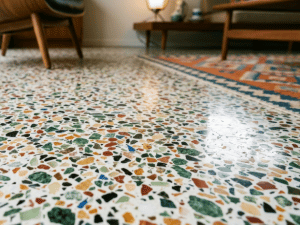
Is That Terrazzo Under Your Carpet Worth Restoring?
You pull up old carpet expecting plywood or concrete, and suddenly there it is: terrazzo. Maybe it is covered in adhesive, dotted with tack-strip holes, scratched, stained, or so dull that you can barely recognize it. Is it actually worth saving?
In many cases, yes.
Older homes and commercial buildings often have terrazzo floors that were covered decades ago when carpet became the preferred flooring choice. Once that carpet is removed, the terrazzo underneath can look rough enough to make you wonder why anyone would bother restoring it.
We understand the temptation to start scraping, sanding, or pulling at everything left behind.
But before you reach for a pry bar or floor sander, take a closer look. What looks like a damaged floor may simply be a floor that has been hidden and neglected for years.
For homeowners in the Sarasota / Tampa Bay FL area, as well as property owners and managers dealing with older buildings, the first step is understanding what you are actually working with.
Be Careful With Those Carpet Tack Strips
One of the first surprises after removing carpet is how securely the tack strips were attached.
Carpet tack strips are commonly nailed around the perimeter of a room, sometimes directly into the terrazzo. If you simply slide a pry bar underneath and pull upward, you can break out pieces of terrazzo around the nails.
A small nail hole can quickly become a much larger chip.
When possible, we choose methods that minimize stress on the surrounding floor. In some situations, the wooden tack strip can be carefully removed while leaving the nails in place. The exposed nails can then be cut flush with the floor using appropriate equipment.
Once the terrazzo is ground, honed, and polished, the remaining metal is often barely noticeable.
Existing chips and holes can also be repaired with a compatible terrazzo repair material. An exact color match is not always possible, especially with older floors that have changed appearance over decades, but careful repairs can blend surprisingly well in the hands of your PRO.
Found Carpet Adhesive? Don’t Start Scraping Yet
Old carpet may leave behind adhesive at seams, transitions, doorways, or across much larger areas. Carpet padding can also stick to the terrazzo after years of contact.
This is not the time to attack the floor with a metal scraper, household adhesive remover, grinder, or whatever strong solvent happens to be under the sink.
The wrong approach can scratch the terrazzo, spread the adhesive, discolor the cement matrix, or create a bigger restoration problem.
There is another important consideration with older flooring: some black, tar-like flooring adhesives may contain asbestos.
If you uncover a suspicious black or tar-like adhesive, especially in an older building, don’t grind, sand, or aggressively scrape it. Have the material evaluated and tested by a qualified asbestos professional before disturbing it.
Once the material has been properly addressed, we can determine the safest and most appropriate way to deal with the remaining adhesive.
Don’t Be Surprised If the Floor Looks Worse Before It Looks Better
After the carpet comes up, you may find more than you expected:
- Tack-strip holes and chipped edges
- Carpet-pad patterns or discoloration
- Old adhesive
- Rust marks around nails or metal divider strips
- Cracks that were hidden beneath the carpet
- Dark areas from spills, pets, or moisture
- Uneven wear between previously covered and exposed areas
- Areas where the original finish has completely disappeared
None of these automatically means the terrazzo is beyond saving.
Terrazzo is a durable flooring material, and many surface problems can be significantly improved through professional grinding, honing, polishing, and repair.
That said, restoration does not mean every stain or crack will magically disappear. Some staining can penetrate deeply, and some cracks may be related to movement in the underlying concrete. We believe it is important to identify those limitations before work begins rather than promise a perfect result that the floor cannot deliver.
What Happens During Terrazzo Restoration?
At Gulf Coast Surface Restoration, we start by looking at the floor as a whole rather than immediately reaching for the grinder.
We evaluate the type and condition of the terrazzo, look for cracks and loose areas, inspect divider strips, identify previous repairs, and determine whether adhesive, wax, coatings, or other materials are present.
Depending on what we find, restoration may include several stages.
1. Removing Adhesive and Old Coatings
Carpet adhesive, wax, acrylic finishes, paint, and other surface contamination need to be removed before the terrazzo can be properly restored.
The appropriate removal method depends on what is present and how strongly it is bonded to the floor. There is no single remover or technique that works safely for every situation.
2. Repairing Holes, Chips, and Cracks
Tack-strip holes and chipped areas can often be filled with compatible repair materials.
For traditional terrazzo, repairs may involve colored cement or resin combined with marble or other aggregate selected to resemble the original floor.
Older terrazzo can be challenging to match because the original material has aged and changed color. A good repair should blend with the surrounding floor rather than simply stand out as a new patch.
Cracks also deserve attention before they are filled. Some may be old and stable, while others can indicate movement beneath the terrazzo. If the underlying movement continues, a repaired crack may eventually return.
3. Grinding the Surface
Professional diamond grinding can remove surface scratches, adhesive residue, worn coatings, minor surface damage, and some discoloration.
It can also expose a fresh layer of terrazzo aggregate and provide a clean surface for the next stages of restoration.
This is one area where DIY equipment can create more problems than it solves. A handheld grinder or basic floor sander can leave deep scratches, swirl marks, low spots, or uneven aggregate exposure that are difficult to correct.
4. Honing the Terrazzo
After grinding, we use progressively finer abrasives to hone the surface.
Each stage removes the scratches created by the previous stage. As the abrasive becomes finer, the terrazzo becomes smoother and begins to develop greater clarity and sheen.
Skipping abrasive steps can leave scratches behind that become especially obvious once the floor is polished.
5. Polishing the Floor
The final polishing process can produce anything from a softer satin appearance to a highly reflective finish, depending on the floor and the desired result.
More shine isn’t automatically better, though.
In entrances, kitchens, bathrooms, and other areas where water may be present, we also need to consider how the finish will perform under everyday conditions and whether additional slip-resistance considerations are appropriate.
6. Cleaning and Protecting the Restored Floor
Once restoration is complete, the floor should be thoroughly cleaned and allowed to dry.
Depending on the type of terrazzo and how the space will be used, a penetrating sealer may be appropriate. A sealer can help slow the absorption of spills and give you more time to clean them.
It does not make terrazzo stain-proof, and it does not eliminate the need for regular care.
Natural Polish or a Topical Finish?
This is an important distinction when restoring terrazzo.
A naturally polished terrazzo floor gets its appearance from the terrazzo itself through grinding, honing, and polishing. The shine isn’t coming from a coating sitting on top of the floor.
A topical finish, sometimes casually called wax, is different. Acrylic or polymer finishes sit on the surface and can add gloss while providing a sacrificial layer that takes some of the everyday wear.
That can be useful in certain commercial environments where a regular maintenance program is already in place. But topical finishes also require maintenance. As the coating becomes scratched, dirty, or worn, it may need to be scrubbed, recoated, or eventually stripped.
For many homes and other spaces where simpler long-term care is preferred, a naturally honed or polished terrazzo surface with appropriate protection can be a practical option.
We also recommend being cautious about using a coating simply to make a poorly restored floor look shiny. A glossy coating can temporarily hide fine scratches or unevenness, but those problems can become visible again as the coating wears.
How Do You Care for Restored Terrazzo?
Once your terrazzo has been restored, routine maintenance is relatively simple.
We recommend:
- Dust mopping or vacuuming regularly to remove grit and sand.
- Damp mopping with a neutral-pH cleaner appropriate for terrazzo.
- Wiping up spills promptly.
- Avoiding vinegar, acidic cleaners, toilet-bowl cleaners, and harsh alkaline degreasers.
- Using appropriate walk-off mats at entrances.
- Avoiding rubber-backed mats that could discolor the surface.
- Skipping household waxes and “mop-and-shine” products unless specifically recommended.
- Addressing worn areas before heavy traffic creates deeper scratches.
Because terrazzo may contain marble or other acid-sensitive aggregates, acidic cleaners can etch the surface and reduce its polished appearance.
Is Your Old Terrazzo Floor Worth Restoring?
In many situations, an old terrazzo floor is absolutely worth evaluating before you cover it again.
Traditional terrazzo is durable, distinctive, and difficult to reproduce economically today. A floor that looks tired after decades under carpet may have a beautiful surface hiding underneath all that adhesive, staining, and wear.
Whether the floor is in a home, office, retail space, school, hospitality property, or another commercial setting, the same basic rule applies: evaluate before you alter it.
Don’t start pulling nails, grinding adhesive, sanding stains, or applying a coating before you understand what you’re dealing with.
If you’re not sure whether your terrazzo can be restored or what the restoration process would involve, we’re happy to help. You can reach us at (941) 479-9899.
What looks like an ugly, forgotten floor on the day the carpet comes up may be only a careful restoration away from becoming one of the most distinctive surfaces in the building.
FAQs
Q. Can terrazzo under old carpet really be restored?
A. Yes. In many cases, terrazzo hidden beneath old carpet can be restored through a combination of adhesive removal, repairs, grinding, honing, and polishing. The condition of the floor will determine the appropriate approach.
Q. What should I do if there is black adhesive under my old carpet?
A. Don’t grind, sand, or aggressively scrape it. Some older flooring adhesives may contain asbestos. Have suspicious material evaluated and tested by a qualified asbestos professional before disturbing it.
Q. Can carpet tack-strip holes in terrazzo be repaired?
A. Yes. Small holes and chips can often be filled with a compatible terrazzo repair material. Matching an older floor exactly can be difficult, but a skilled restoration professional can often make repairs blend well with the surrounding surface.
Q. Is polished terrazzo better than putting wax over it?
A. It depends on how the space is used. Naturally polished terrazzo gets its appearance from the floor itself, while a topical finish creates a separate protective coating that requires ongoing maintenance. Both approaches can have a place depending on the property and maintenance plan.
Q. How do I know if my terrazzo floor is worth restoring?
A. An evaluation is the best way to find out. Factors such as cracks, staining, adhesive, chips, previous coatings, and the overall condition of the terrazzo will determine what can realistically be restored.
By Fred Hueston. This article is one of a series of Caring For It™ articles written and published on behalf of Surface Care PRO Partners.